
Fire Insurance Plaque on 1 Charlotte Street

This light blue building on Charlotte Street adjacent to Smeaton bridge displays a fire insurance plaque (actually a replica as the original one was stolen). Probably the smallest plaque in our records , the plaque is above the door below the central upper window. It is the mark of the Sun Fire Office with the property’s registration number, 10154, at the bottom. Fire insurance marks were used in the eighteenth and nineteenth century prior to the introduction of municipal fire services. They were fixed to the front of insured buildings as a guide to an insurance company’s fire brigade. The plaques bore the emblem of the company which insured that particular building. If an insurance company’s Fire Brigade found the plaque of a rival company on a building, they might choose not to put out the fire or else they would extinguish the blaze and charge the insuring company. The first company to use the mark was the Sun Fire Office which was established in 1710. Cast metal plaques were made of iron, lead, or sometimes brass. 
0 Comments

The Guildry Plaques on Tay Street

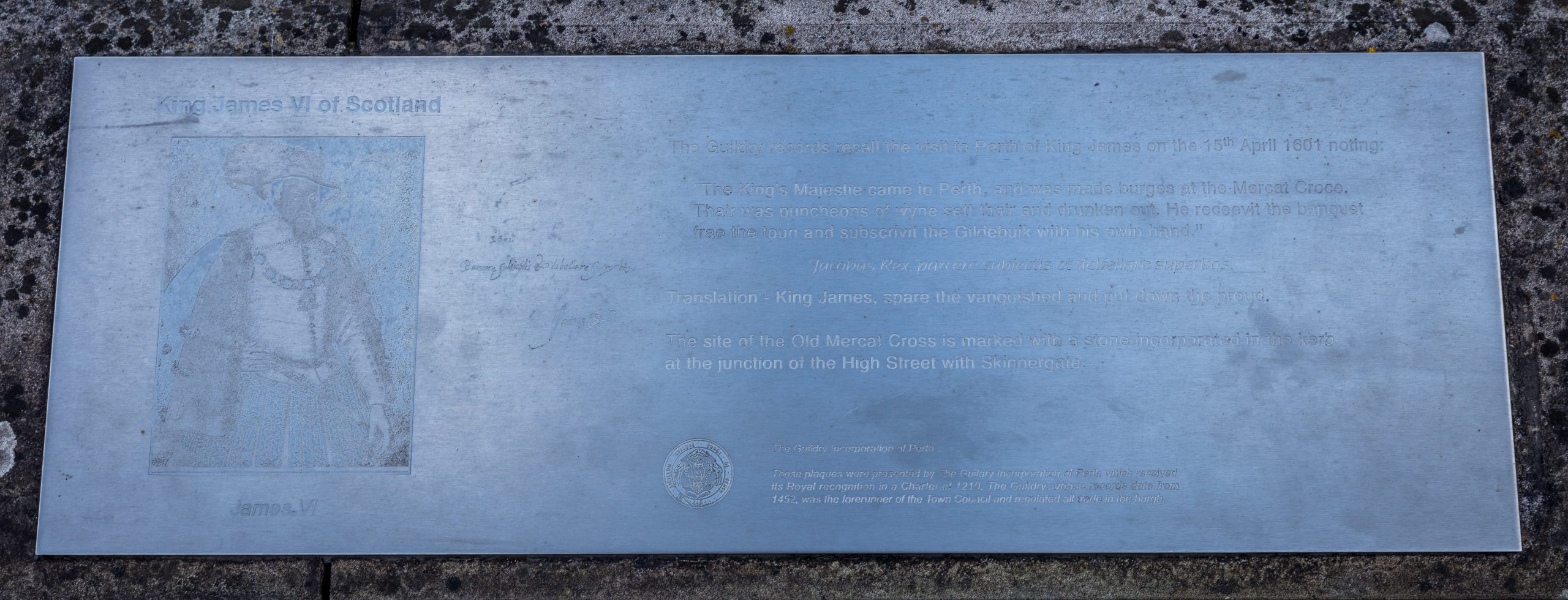
A series of six metal plaques are set on the top of the riverside flood wall on Tay Street, just north of the viewing platform. The plaques were funded by the Guildry Incorporation and describe various elements of the civic history of Perth. The first plaque records the visit of James VI in April 1601, before he became King of the United Kingdom. It records how much he was made welcome with ‘much wine’ and ‘a banquet’ but this was less than a year since an attempt had been made on his life while he resided at Gowrie House in August 1600. The second plaque deals with the previous bridges of Perth which were destroyed by the river and gives details of the current bridge. The plaque also outlines the extent of the Guildry’s responsibility for the bridges. Plaque number 3 sets out the reasons why Perth was built where it is, showing a view of Perth in 1665. Prior to the building of the Smeaton bridge, Perth was without a bridge between 1621 and 1771. Plaque 4 plaque describes the crossing the river by ferry. A gravestone in Kinnoull graveyard reflects the obvious importance of ferrymen. Although Perth currently retains…

0 Comments

Visit to Perth by Robert Burns

This plaque in High Street records the site of the Croom’s Tavern in which Burns stayed during his visit to Perth in 1787. The plaque has been moved, having previously been further down the High Street in the close leading to the Scott Street car park.

2 Comments

History of Golf in Perth

Until recently there was a modern information board close to the railway bridge over the Tay, setting out the history of the game in Perth. There is a reference to James IV playing in Perth in 1504 despite the recently past  laws prohibiting the game. (see Archery Butts). Beside it was another board entitled 'Perth and the Railways' and nearby one called 'Wildlife on the Tay' but all of these have been removed.

0 Comments

Sir Walter Scott statue on the South Inch

Sir Walter Scott’s statue on the South Inch just off Marshall Place was erected as a token of appreciation for his setting a novel in Perth. The Statue was originally at the foot of the High Street before being moved to its current position in 1877. Sir Walter made a series of visits to Perth and Perthshire where he derived his inspiration to write the novel “The Fair Maid of Perth”. The story is based on events involving the “Battle of the Clans”. To give the tale an air of authenticity he then nominated particular dwellings as the homes of the principal characters. There was an old tale in Perth that when Scott’s dog Maida heard the bells of St. Johns strike midnight on Hogmanay, Sir Walter went for a drink at a public house close to the Kirk. The story had two major flaws, one the pub would have been closed, due to the licencing laws at that time and secondly stone dogs are notoriously hard of hearing. Maida went missing in 2016 (when it turned out that she had just gone for repairs) and again in 2020 (presumed to be theft). Police have so far failed to recapture her.…

0 Comments

The Fair Maid’s House in North Port

The house was chosen by Sir Walter Scott as the home of Catherine Glover, the heroine in his 1828 novel “The Fair Maid of Perth”. Scott had been shown round the oldest parts of Perth in his search for an authentic setting for his novel. In a similar fashion to his choice of the Hal O The Wynd house the story pre-dates the buildings. Some of the walls date from 1475 but most are from 1629 and the whole building was extensively renovated in 1893-4. For 150 years it was the meeting place of the Glovers Incorporation of Perth. It now stands on North Port behind Perth Concert Hall. It house a visitor Centre (currently closed) and is part of the headquarters fo the Royal Scottish Geographical Society. The board across the road shown here is Panel 4 of the Perth Medieval Trail entitled 'Outside the Burgh' and replaces an earlier board (also pictured).

0 Comments

Hal O the Wynd House in Mill Wynd

The naming of this building is entirely due to Sir Walter Scott. He named the house in Mill Wynd on a visit to Perth to find material to provide an apparently authentic background for his novel ”Fair Maid of Perth”. The building dates from 1774, so clearly did not exist in the time of Hal O the Wynd. It was originally used as a warehouse and factory. (Hunter, T., Perth Weavers and Weavers, 1936, p91 & p48) Scott similarly attributed the Fair Maid’s House to the Glover Family The legendary figure of Hal O The Wynd, whose actual name was believed to be Henry Wynd, or as the Highlanders called him “Gow Chrom” meaning the “bandy-legged smith, was said to have taken part in the Battle of the Clans in 1396. (Sir Walter Scott, Rob Roy, Penguin 1995 f.note P315) Hal O The Wynd was a powerful local blacksmith/armourer who was drafted into the  army of Clan Chattan when one of their number absconded. He is said to have made a major contribution to the victory of Clan Chattan.  (Marshall T. H., The History of Perth: From the Earliest Period to the Present Time, 1849 pp33-34)

2 Comments

Kinnoull Burial Ground

An excellent information board on the wall outside Kinnoull Burial Ground describes many of the most important headstones and descibes the history of the graveyard and Kinnoull Church. The headstone for George Gray Millias, the son of Sir John Everett Millias Bart. P.R.A. and his wife Effie Chalmers Gray is situated within this graveyard. Effie Gray is also recorded on the headstone. She was the first wife of John Ruskin. See also Bowerswell House - Effie Gray. The graveyard also contains a number of very old gravestones showing various crafts and occupations. There is a particularly large stone depicting a Ferryman, signifying his importance to the city.

0 Comments

Bowerswell House – Effie Gray

Bowerswell House, now part of Bowersell Memorial Homes, was the home of the Gray family whose daughter Effie Gray was married initially to John Ruskin, the influential art critic. Following her divorce, she married the pre-Raphaelite artist John Everett Millias. There are reproductions of some of Ruskin’s paintings with explanatory text in the dining room which is occasionally open to the public on Doors Open Days. The refurbishment of the House and its surroundings in 1991 are remembered in further plaques and there is a framed award by Perth Civic Trust. See also Bowerswell House War Memorials.

2 Comments

John Ruskin boyhood home in Rose Terrace

There is a plaque at 10 Rose Terrace recording the home of Mrs. Richardson, an aunt of John Ruskin, the influential art critic. Ruskin describes spending  boyhood holidays in Perth. (Praeterita,1885-1889, Ruskin. J. pp53-60. Rupert Hart-Davies, London, 1949).

0 Comments
Close Menu