Perthshire Society of Natural Science Natural History Museum – Tay Street

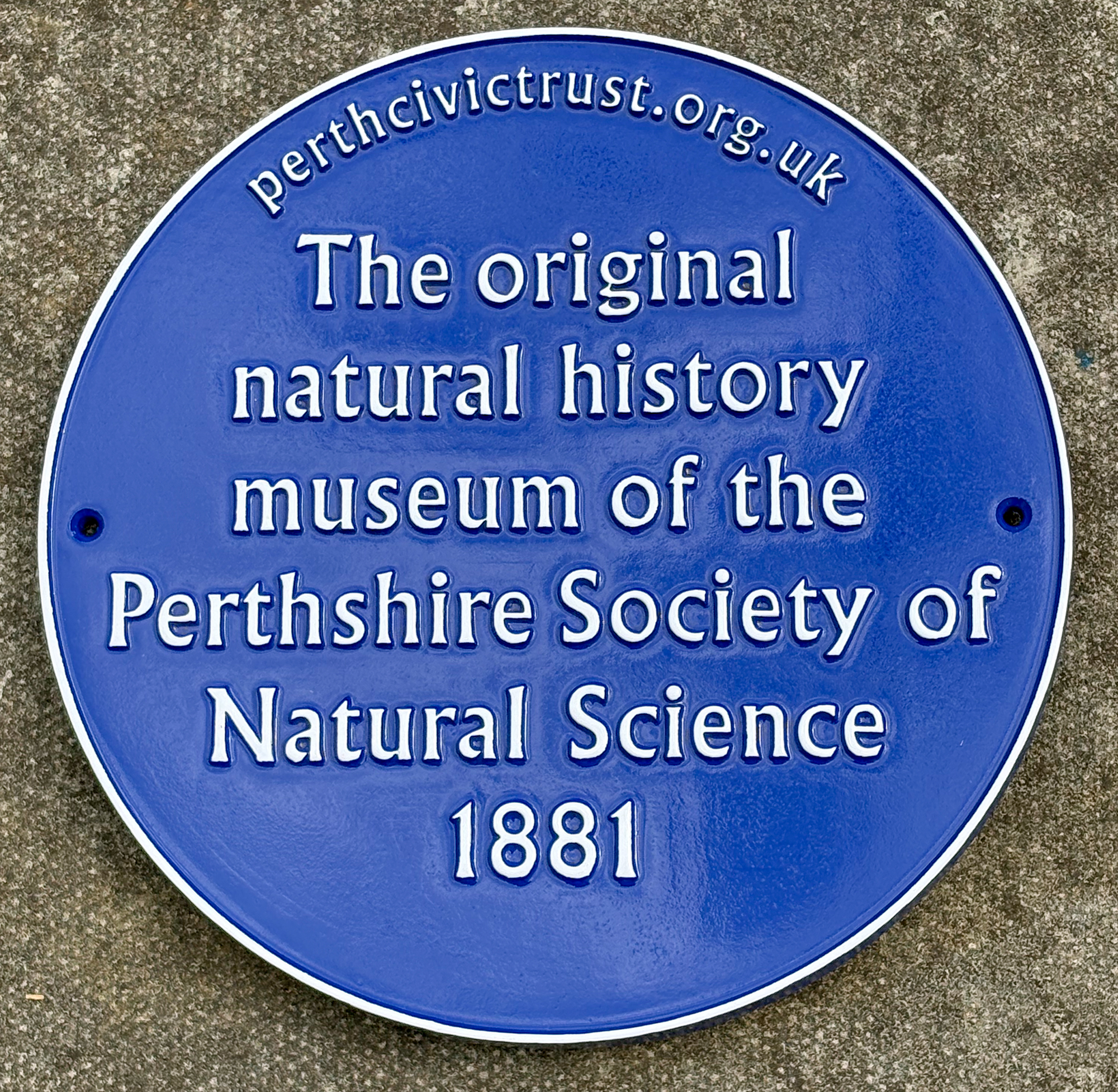
Our fifth Perth Civic Trust blue plaque was unveiled on 23rd August 2026 in Tay Street, on the facade of 66 Tay Street which housed the original Natural History Museum of Perthshire Society of Natural Science which opened in 1881. As soon as PSNS was formed in 1867, Dr Francis Buchanan White said in his inaugural address on 7th March 1867. “As regards the formation of a Museum, the Society, while not neglecting to form a good general typical collection, should more especially devote itself to the acquisition of as perfect a museum as possible of all natural products of the County”. An ambition of the Society was to establish a museum with a fine natural history collection. It was to be as comprehensive as possible in its collections of Perthshire’s rocks, minerals, plants and animals. In 1877 Sir Thomas Moncreiffe, the President, proposed the society should build the museum, including a library and lecture hall, in Tay Street. The businessman Robert Pullar of Perth’s North British Dyeworks, contributed generously to the cost of the building. After Sir Thomas’s unexpected death, the new museum, opened in 1881 was named in his honour, the Moncreiffe Memorial Natural History Museum. The museum was…

0 Comments

Charles I visit to Perth in 1633

King Charles I ascended to the English throne in 1625 and was crowned in England that year. However, the Scots insisted that he should also be crowned in his northern kingdom. The ceremony took place in Edinburgh, at the Palace of Holyrood House, on 18 June 1633, amid an elaborate and extravagant royal tour. This tour included a visit to Perth, commemorated in this stone plaque in the flood defence wall in Tay Street. It recounts that he was entertained by members of the Glover Incorporation performing a sword dance on a wooden platform moored on the River Tay.

0 Comments

The Monks Tower

One of the carved alcoves in the flood defence wall on Tay Street tells of the Monks Tower. The Monks Tower was situated in the south-east corner of the gardens of Gowrie House and jutted out over the river. The tower acted as a lookout post, working in tandem with the Spey Tower to defend the southern approaches to Perth. The Tower later served as an ammunition store prior while Gowrie House was being used as a barracks prior to its demolition at the end of the 18th century.

0 Comments

The Gowrie House and Conspiracy

The large plaque on the front of the Sherriff Court in Tay Street records the events of the 5th August 1600 when an attempt was made on the life of James VI. The Gowrie House was built in 1520 by the Countess of Huntly who later sold it to the Ruthven family. After the Gowrie conspiracy the Ruthven family, who were considered responsible for the attack on the king, forfeited the building which was then held jointly by the Murrays of Stormont and Perth Town Council. Charles II stayed in Gowrie House after his Scottish coronation in Scone in 1651 before departing for Worcester. After the Restoration he returned in 1663 to be entertained in Gowrie House by the Earl of Kinnoull. In 1746 the house was given by Perth Town Council to the Duke of Cumberland who sold it to the Board of Ordinance for use as cavalry barracks until its demolition in 1807. (The Stewart Society) The building occupied an area greater than the County Buildings and the Prison, now a car park, which were erected on the site following the demolition of Gowrie House. The river frontage of the grounds extended for 275 metres from a line beyond…

0 Comments

Aschaffenburg plaque outside 2 High Street

A circular metal plaque has been set in the pavement outside the main entrance to the Council Headquarters at 2 High St. It bears the coat of arms of Aschaffenburg. Perth was twinned with Aschaffenburg in 1956. Aschaffenburg has a population of 70,000, it stands on both sides of the River Main in Bavaria in south-west Germany. On the flood wall in Tay Street the twinning is commemorated by a stone plaque with the coat of arms of Aschaffenburg.

0 Comments

Former Council Offices, Police Station and Tolbooth

This historic site occupies the corner of the High Street and Tay Street. The entrance doorway of the old Perth Town Council Administrative Offices is on Tay Street. There is no plaque there at present, though doubtlessly one will appear in due course. The old police station, on Tay Street, was built in 1879 as part of the Perth Town Council Administrative Offices on the site of the Old Tolbooth. Above the doorway is the inscription setting out what would now be described as the mission statement of a police force. The text was originally on the medieval tolbooth.

0 Comments

Water Vennel

Water Vennel runs from the Watergate down to Tay Street. A small plaque near its junction with Tay Street tells of its importance and gives some history of the Gowrie House whose northern boundary was formed by Water Vennel. This was an important access to the river when Gowrie House and its gardens  blocked so much of the river frontage.

0 Comments

Perth Harbours

On Tay Street just south of Queen's Bridge and opposite the Sherriff Court is Panel 1 of the Medieval Trail which explains how Perth has been a ‘Perfect Location’ since at least medieval times. This replaced an earlier information board entitled 'Harbours of Perth' also pictured. In Medieval times the harbour was approximately where the aptly named Quayside Court housing complex now stands. The channel corresponds to where Canal Street now runs.

0 Comments
  • 1
  • 2
Close Menu