Town and County Bank

Now a cosmetic dentistry centre, the building at 31 South Methven Street at its western corner with High Street was formerly the Town and County Bank and bears its crest. The building was erected in 1888-1889 at a time when much of central Perth was being redeveloped. The Bank's main office was in Aberdeen. After a series of takeovers the Town and County Bank became part of the Clydesdale Bank. Gifford reports the in the triangle between the arched door, the wall and ceiling there are two men with moustaches which merge into fruit.

0 Comments

Railway Station platform 7 plaque

A recently placed plaque on platform 7 tells of the past importance of Perth as a railway hub and how it came to be designed in 1848. Major alterations then took place in 1885-7 and 1911. We are unsure who commissioned or produced this plaque. If you know please let us know in the comments box below. Perth and Kinross Archive published a Facebook post on 7th Dec 2023 with photos revealing just how impressive the original Tudoresque main building looked, and how it was partially obscured by the later 1880s additions. As the metal roof of this later part is now decaying, it is to be hoped that one day we shall be able to see the main building as it once was. This is just the kind of issue that Perth Civic Trust is interested in.

0 Comments

Bridgend Toll House

This is one of three toll houses in Perth still remaining, although there used to be more. The others still existing are on the Edinburgh Road and on the Dundee Road. There used to be one on the Crieff Road, Balhousie Toll House, opposite Unity Terrace.  It was still there in the late 1970’s and had been converted into a house. It was later demolished along with an arcade of shops to make way for Toll House Gardens, part of the Fairfield redevelopment of Hunter’s Crescent.  There was also one at the end of New Row to catch incoming Glasgow Road traffic.  It is long gone.  There was also one as part of the old Tollbooth at the bottom of the High Street, before Smeaton’s Bridge, to catch river traffic.  There may well have been others. Now vacant, Bridgend Toll House contained J S Lees greengrocers for many years. It is now on the Buildings at Risk register with Historic Environment Scotland: J. S. Lees Grocers (Former), 1, West Bridge Street, Perth | Buildings at Risk Register The Bye Law on the notice board on the toll house sets out the rules for a locomotive (traction engine) crossing the bridge by…

0 Comments

Building at 25 St John Street

According to a plaque beside the left entrance, the building at 25 St John Street, erected between 1846-1847 in the style of an Italian Renaissance palazzi, was designed by David Rhind, (1808-1883), a pupil of Pugin. Pugin worked with Barry on the design, construction and internal furnishings  of the Palace of Westminster. It was originally the local headquarters of the Central Bank, then the main Perth branch of the Bank of Scotland and most recently Lakeland. Rhind is responsible for a building of a similar design on the corner of South Street and Princes Street. The building currently houses a restaurant.

0 Comments

Fleshers Guild building in South Street

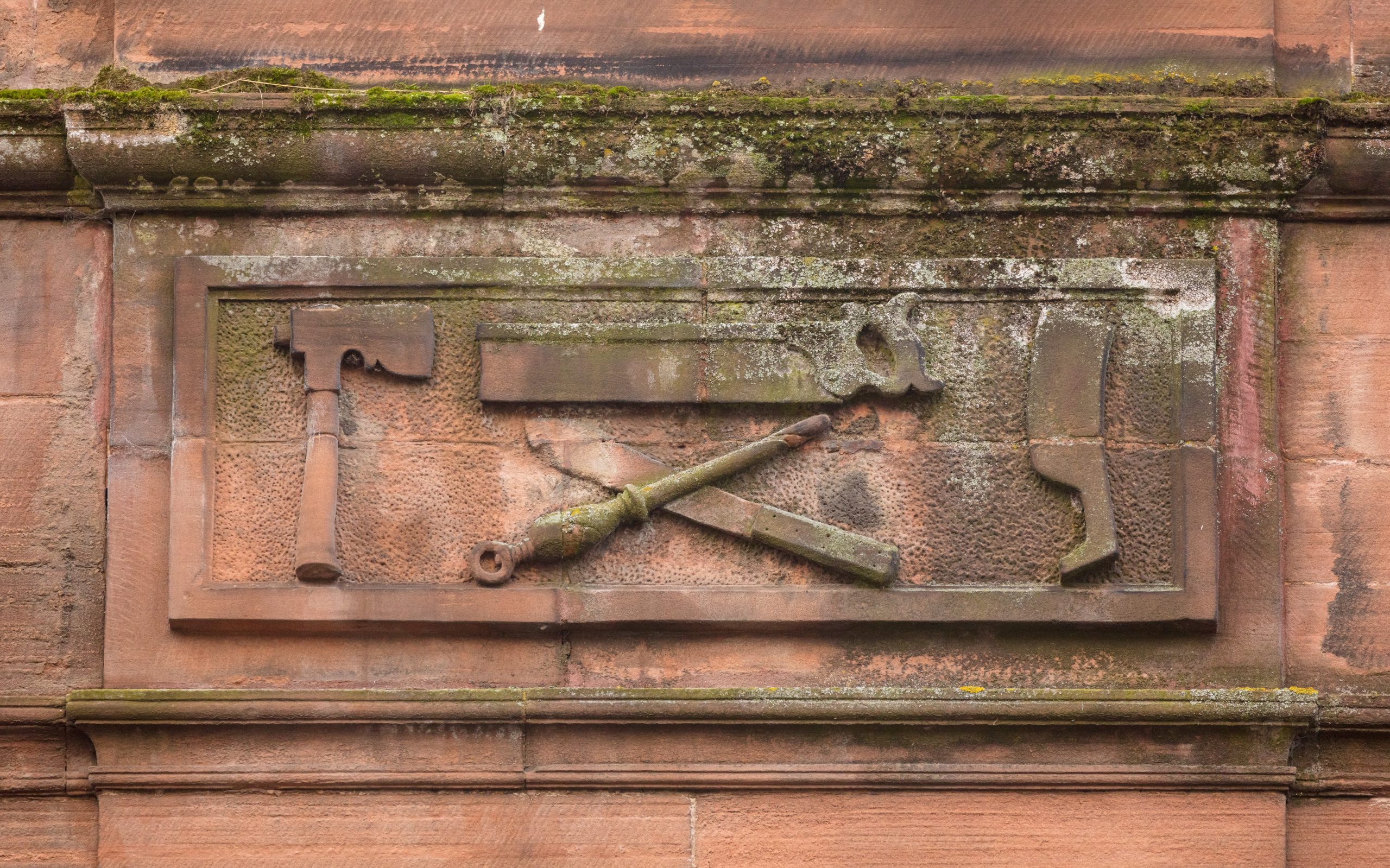
This Fleshers Guild sign is on a building in South Street (on its south side facing Fleshers’ Vennel). The Fleshers Guild erected the building in 1889 and used the hall until the 1920’s. The building replaced the Flesher’s Incorporation abattoir which previously stood on the site. This area of the South street had since Medieval times been the part of Perth used by the Fleshers both to slaughter animals and to sell meat in the market. (Perth, Street by Street, Paul Philippou). Meat and other commodities were traded on prescribed days and rules were strictly enforced. They held their market in South Street before moving to the Fleshmarket (the area in front of St. John’s Kirk). Fleshers’ Vennel leads from South Street to St. John’s Square. They owned property in this part of the town.

0 Comments

Marriage Lintel in Fleshers Vennel

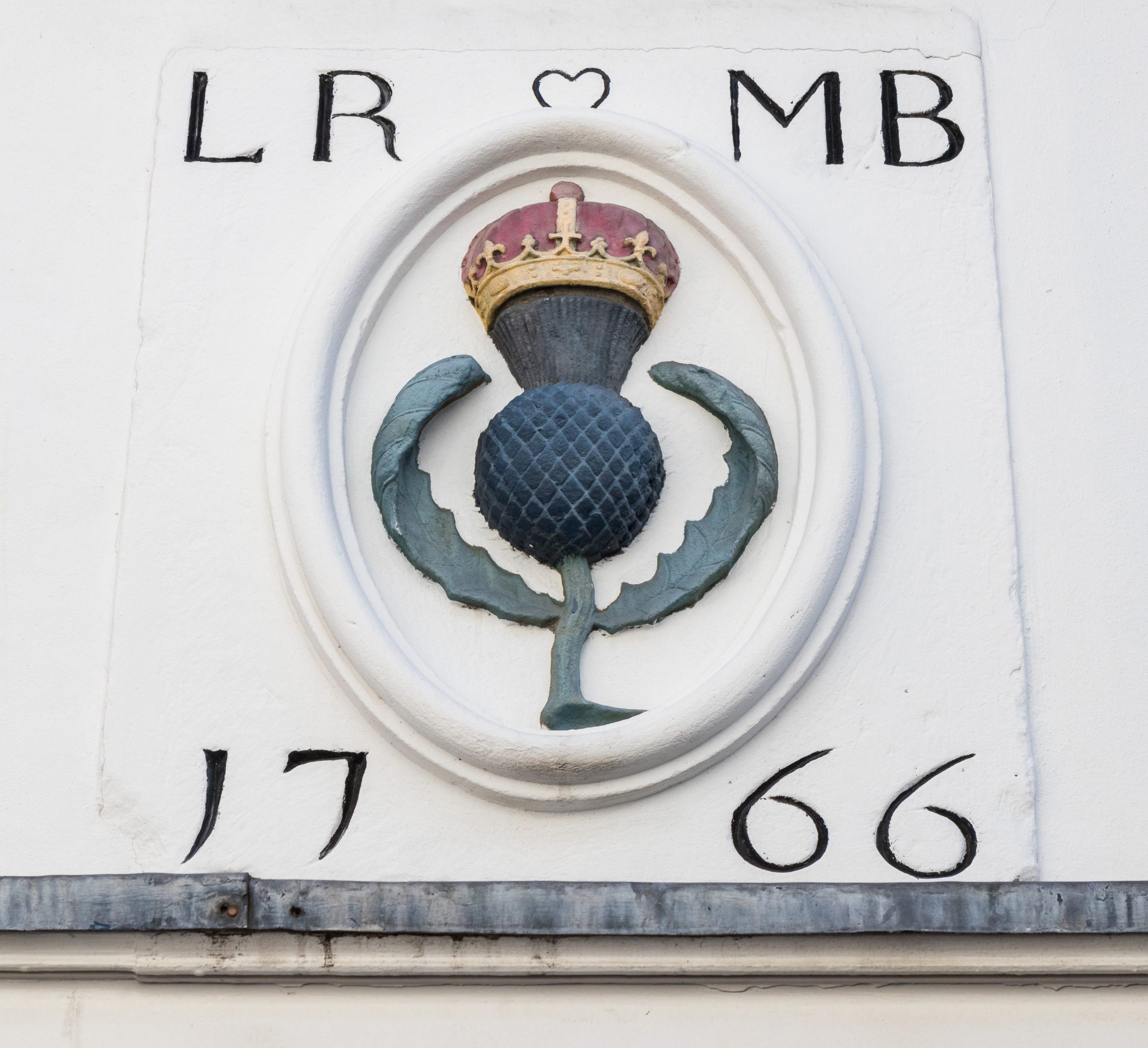
The initials LR and MB and the date 1766 surrounding a crest are sited high above the west facing gable in Fleshers’ Vennel. These are believed to be the initials of the married couple who either occupied the property, or had it built in 1766. The Vennel, which itself bears no plaque, led from the South Street where fleshers from out of town had to wait with their meat before entering the market near the kirk. Meat and other commodities were traded on prescribed days and rules were strictly enforced.

0 Comments

Fountain Close, the Vennels of South Street

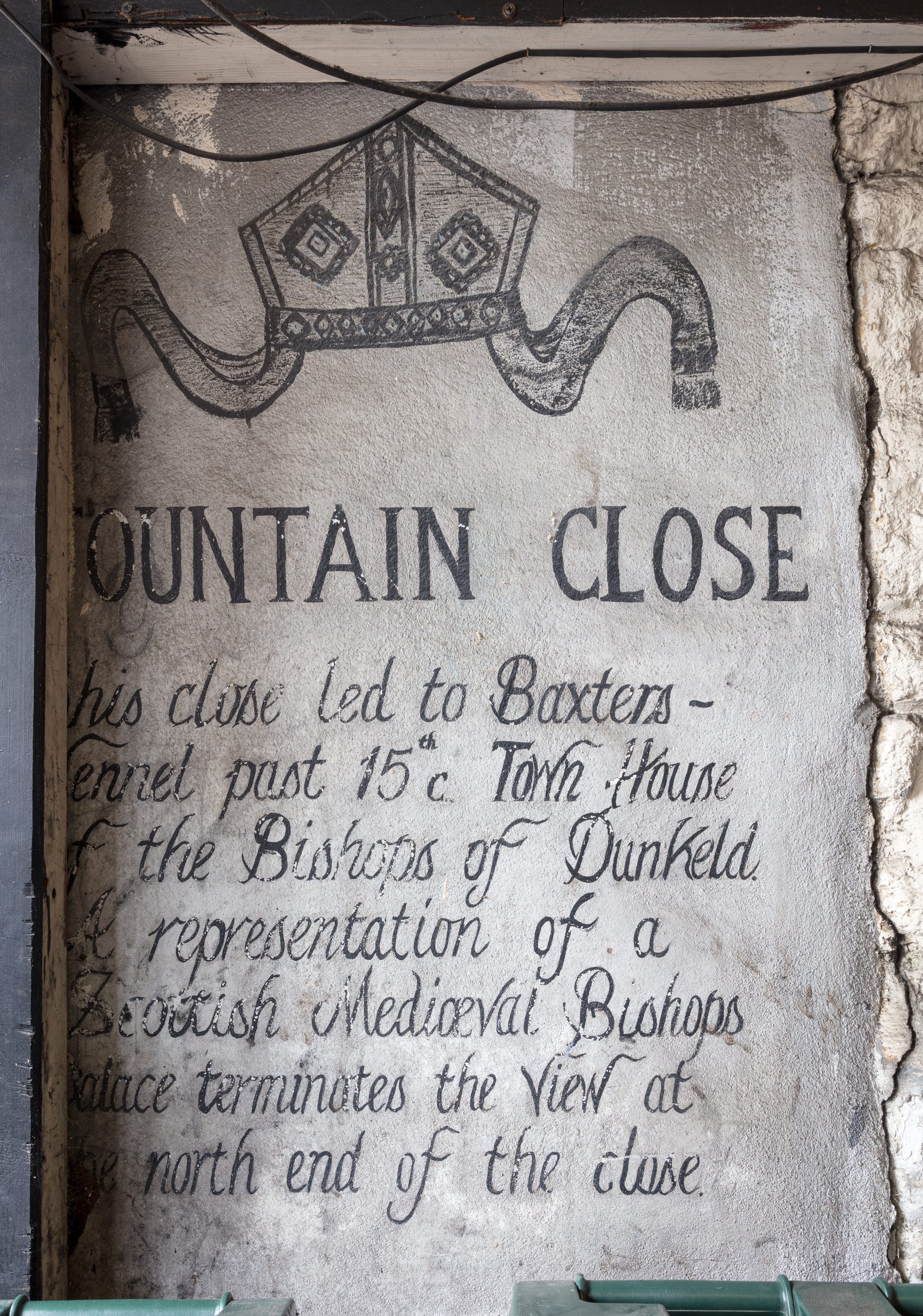
Fountain Close is at 17 South Street on its north side. Until 2022, painted on the whitewashed walls were 14 descriptions of the old vennels of Perth and their relationship to the old Guilds of Perth with emblems of the Guilds. The descriptions were painted directly on to the walls. It is believed the images were painted by pupils of Kinnoull School under the guidance of Miss Rhoda Fothergill. They have now all been whitewashed over as can be seen in the first photo. The remainder of the photographs were taken in 2018 and 2019. Also shown is part of a Celtic cross painted on the end wall. Some of the vennels remain in existence although others are lost. Traces of the Meal Vennel remain as the exit of the shopping centre on to the High Street and the loading bank on the South Street. The close when in use passed by the 15th century Bishop’s House and on into Baxters Vennel. A board on a corner building in St John Street also confirms the existence of the Bishop’s House prior to its demolition in 1821.

0 Comments

Baxters Vennel

There are several vennels in Perth, not all towns have them. The word is derived from the French “venelle” meaning a narrow lane between buildings. Baxters Vennel goes between St John Street and the Watergate, along the side of the former McEwans/Beales building. Walking along St John Street from South Street it is the first opening on the right. The plaque on the south side of the Vennel explains that Baxter was the old Scots name for bakers. There is evidence that the Baxter Incorporation had property in this area including a “Bakers Hall”. The plaque was donated by McEwans of Perth; much of the text describes the origin and development of the store.  In 1868 when Perth had a population of only 25,000 there were 16 draper shops in St. John Street.

0 Comments

City Mills in West Mill Street

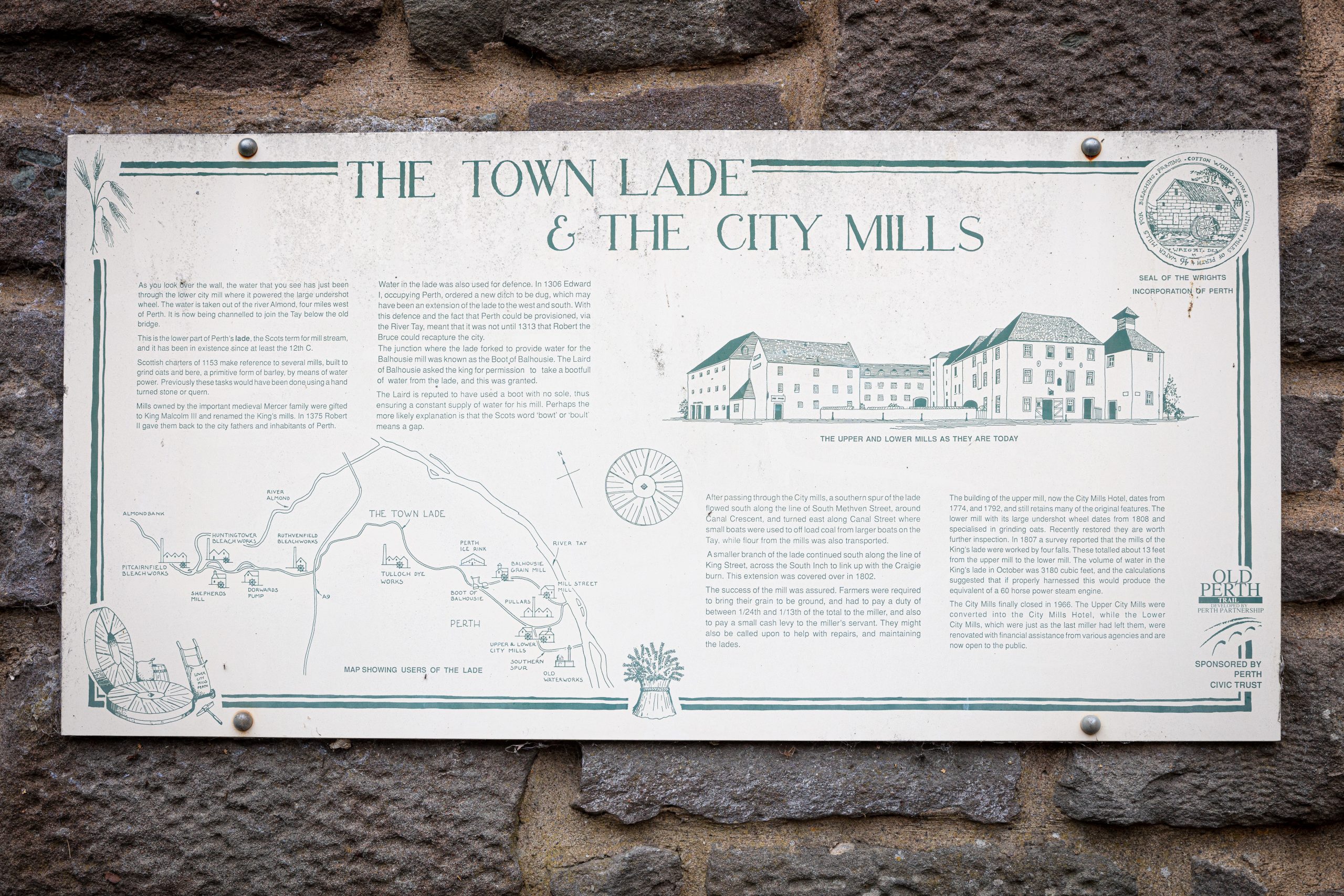
A modern information board on the east side of the City Mills near the Lade gives full details of the importance of the Lade and the City Mills. (This information board was sponsored by the Perth Civic Trust.) There were almost certainly mills on this site in the 12th century. Commercial activity continued until 1966. Until fairly recent times the importance of the Lade was confirmed by the annual inspection carried out by members of the Town Council. The buildings were restored by Perth and Kinross Council between 1982 and 1988 and became a working mill again for some years. There is a plaque inside the Mill commemorating this. Later it housed Perth Tourist Information Centre. The buildings are now used by Perth and Kinross Heritage Trust and are occasionally open on Doors Open Days. Plans to open up as a working mill and visitor attraction were sadly abandoned in 2023.

0 Comments

Mercat Cross in New Scone

This cross in Cross Street, New Scone is a replica of the Old Scone Mercat Cross, still to be found in its original position in the grounds of Scone Palace. It was erected in 1903.

0 Comments
Close Menu