Post Medieval period

Cunningham Graham Close, High Street

Bearing the date 1699 on the lintel, Cunningham Graham Close at 13-17 High Street is said to be the oldest continually inhabited building in Perth. The building is three storeys and an attic. A monogram with the carving "RG, EC" and its year of construction is located above the entrance to the close. These initials refer to Robert Graham and Elspeth Cunningham, for whom the building is named. It was restored in 2015-2016. The project was carried out by the Owners’ Association with the support and encouragement of both Perth and Kinross Council officers and Perth and Kinross Heritage Trust through the Perth City Heritage Fund. Perth and Kinross Heritage Trust recorded on this on their new plaque to the right more details on their web site Historic Tenement Repairs - Perth and Kinross Heritage Trust (pkht.org.uk). In 2016 this project won the biennial Perth Civic Trust Award.

0 Comments

Black Watch Castle and Museum

Balhousie Castle on Hay Street dates from 1631 but became the Black Watch Museum in 2009. South of the entrance is statue and inscription to remember the fallen of the Black Watch. Two plaques on the castle walls remember Field Marshall the Earl Wavell who as General Wavell commanded the 8th Army in North Africa where he defeated the Italians. Wavell was appointed Commander in Chief for Middle East. Following service in North Africa he was appointed to take charge of the defence of India in the Burmese theatre. Wavell’s final appointment was as Viceroy of India.  A plaque beside the west gate commemorates the opening of the Gardens and the dedication of the gates to the memory of Field Marshall the Earl Wavell by his widow, Lady Wavell. The site also exhibits a series of plaques acknowledging the association of Queen Elizabeth, Queen Mother with the Regiment.

1 Comment

Former Perth Grammar School

The modern Perth Grammar School in Muirton has existed since 1971 but was not the first school to bear that name. A plaque high on the north side of South Street at its junction with Princes Street outlines a small part of the history of the original Perth Grammar School. The first recorded evidence of the school is in a charter of 1150. Robert, Bishop of St. Andrews together with a number of his successors confirm the presence of the school as part of the organisation of the church. By 1560 the Town Council, together with the reformed church had taken control of  the management of the school. (The History Of Perth Academy, 1932, E. Smart,  Milne, Tannahall & Methven, Perth, p30.) The school was demolished by Cromwell in 1652 but rebuilt in 1773. It was transferred to Perth Academy in Rose Terrace in 1807. When additional secondary school places were required in 1971, the new school in Muirton was given the long redundant title of Perth Grammar School. The old buildings were converted into a theatre which operated from 1810-1819 but burned down in 1823. Further details of the school and its surrounds are to be found on a plaque…

0 Comments

Guildhall in High Street

Number 102-106 High Street was once the site for the Guildry Incorporation's Guildhall. On the actual building a plaque giving the date of the construction of the original Guildhall in 1722 and rebuilding in 1907. In the pediment the figures of Commerce and Industry support the coat of arms of the city of Perth under the Scottish crown. A plaque commemorating the opening of the new Guildhall in 1907, also a roll of honour for Guild members who fell in World War I is held in the current Guildry Incorporation offices in George Street.

0 Comments

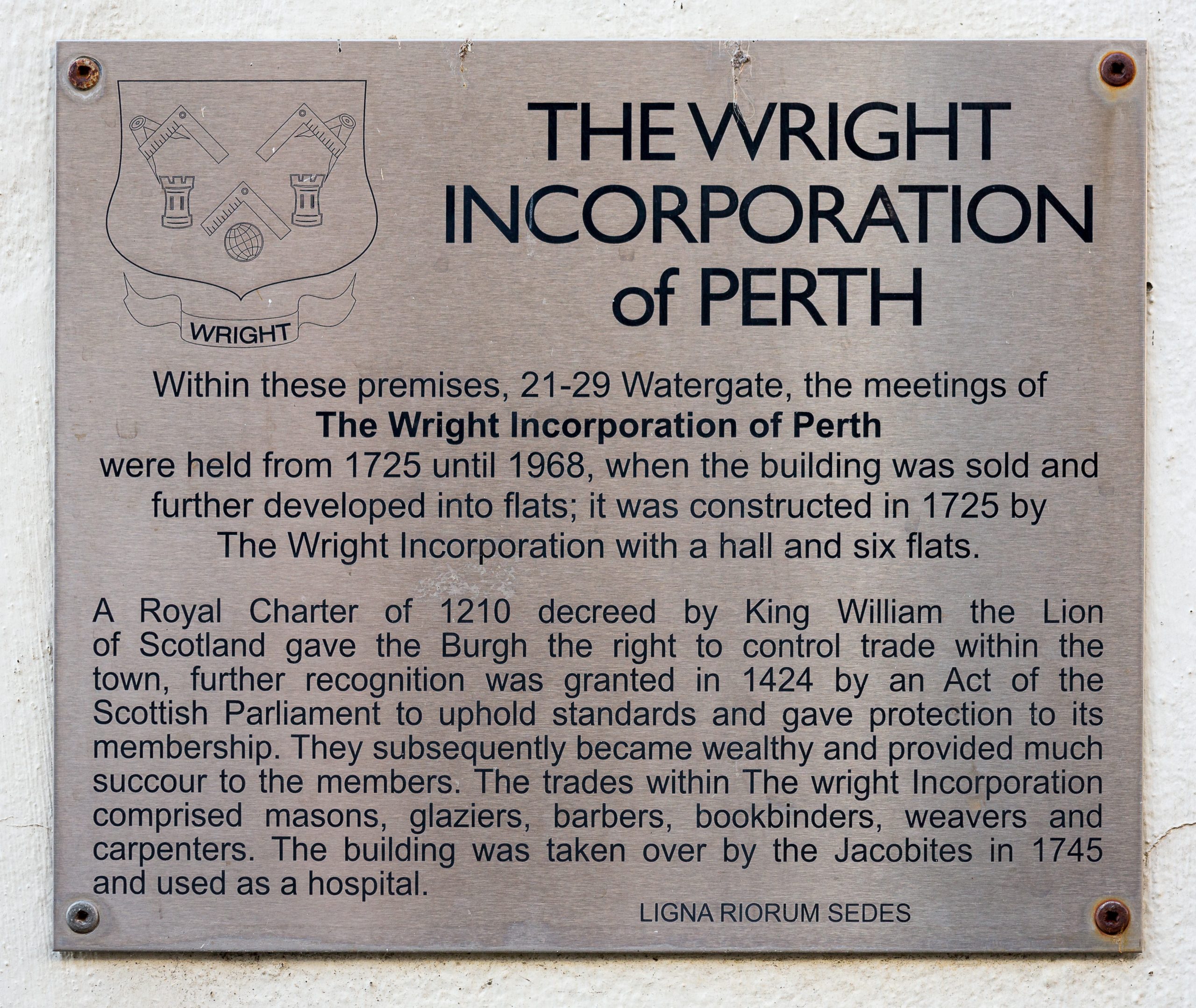
Wright Incorporation in Watergate

The building dated 1725 at 21-29 Watergate was occupied by the Wright Incorporation of Perth from its construction in 1725 until as recently as 1968. The Wright Incorporation of Perth was one of a number of Guilds which were given monopoly rights to trade within the city, goods relating to their particular craft. The Incorporations were empowered to decide who should be admitted to the Guild and to set rules and standards to which members were required to adhere. The Wright Incorporation looked after the interests of masons, weavers, glaziers, barbers, carpenters and bookbinders. In 1833 they lost their authority to control trade and became charitable organisations. This building may also have been used by masons. In 1745 it was briefly used as a hospital by the Jacobite army.

0 Comments
Close Menu