Railway Station – William Downie
William Downie’s 2006 retiral plaque is on platform 5. He is described as being the last of the “time served locking fitters” showing how the skills needed by railway employees had changed.
Perth Station even has a Secret Garden located to the left of the main entrance, on platform 2 and 3/4(!). It is run by the volunteers of Perth Station Garden Club – see their Facebook page.
Large ornate clocks are prominent on platforms 4 and 5. These are the original clocks made by J.A. Ritchie of Edinburgh who was also responsible for the floral clock in Princes Street Gardens, Edinburgh.
The railway bridge over King’s Place is dated 1849 which is also the date of first wooden bridge over the Tay allowing the completion of the line to Dundee. The railway bridges over King Street and Princes Street have explanatory information boards on the street underneath.
Pullar House at numbers 35-49 Kinnoull Street and occupying much of Mill Street as well, contains the offices of Perth and Kinross Council. Before conversion in 1999/2000 this building was Pullars of Perth, an extensive dyeworks owned by the Pullar family. A plaque commemorating the Jubilee in 1898 of the service of Sir Robert Pullar, son of the founder of the business. The business was founded in Burt Close in 1824. A second plaque records those employees who lost their lives in the two wars. This is another example of businesses recording the names of fallen colleagues as also did…
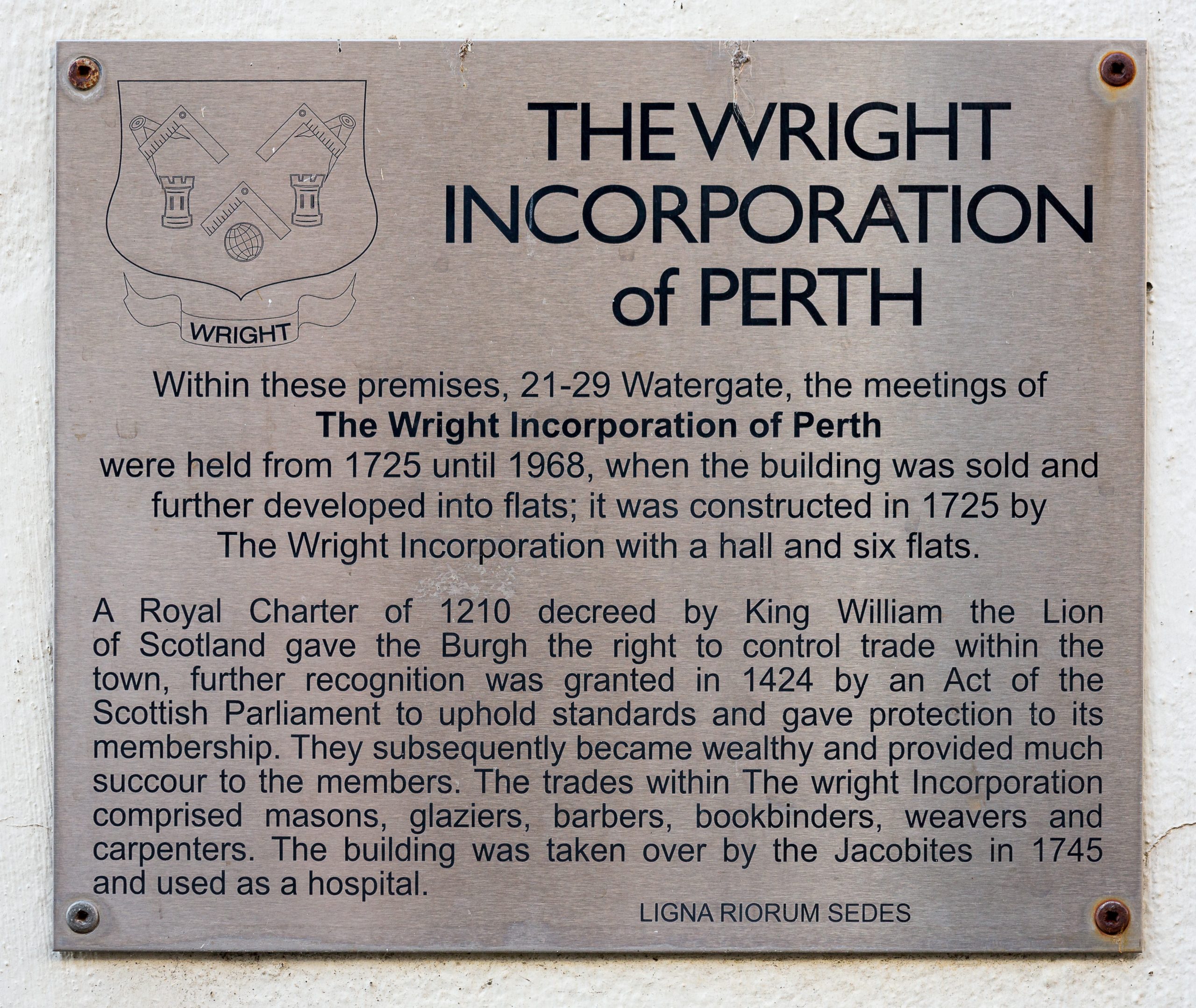
The building dated 1725 at 21-29 Watergate was occupied by the Wright Incorporation of Perth from its construction in 1725 until as recently as 1968. The Wright Incorporation of Perth was one of a number of Guilds which were given monopoly rights to trade within the city, goods relating to their particular craft. The Incorporations were empowered to decide who should be admitted to the Guild and to set rules and standards to which members were required to adhere. The Wright Incorporation looked after the interests of masons, weavers, glaziers, barbers, carpenters and bookbinders. In 1833 they lost their authority…

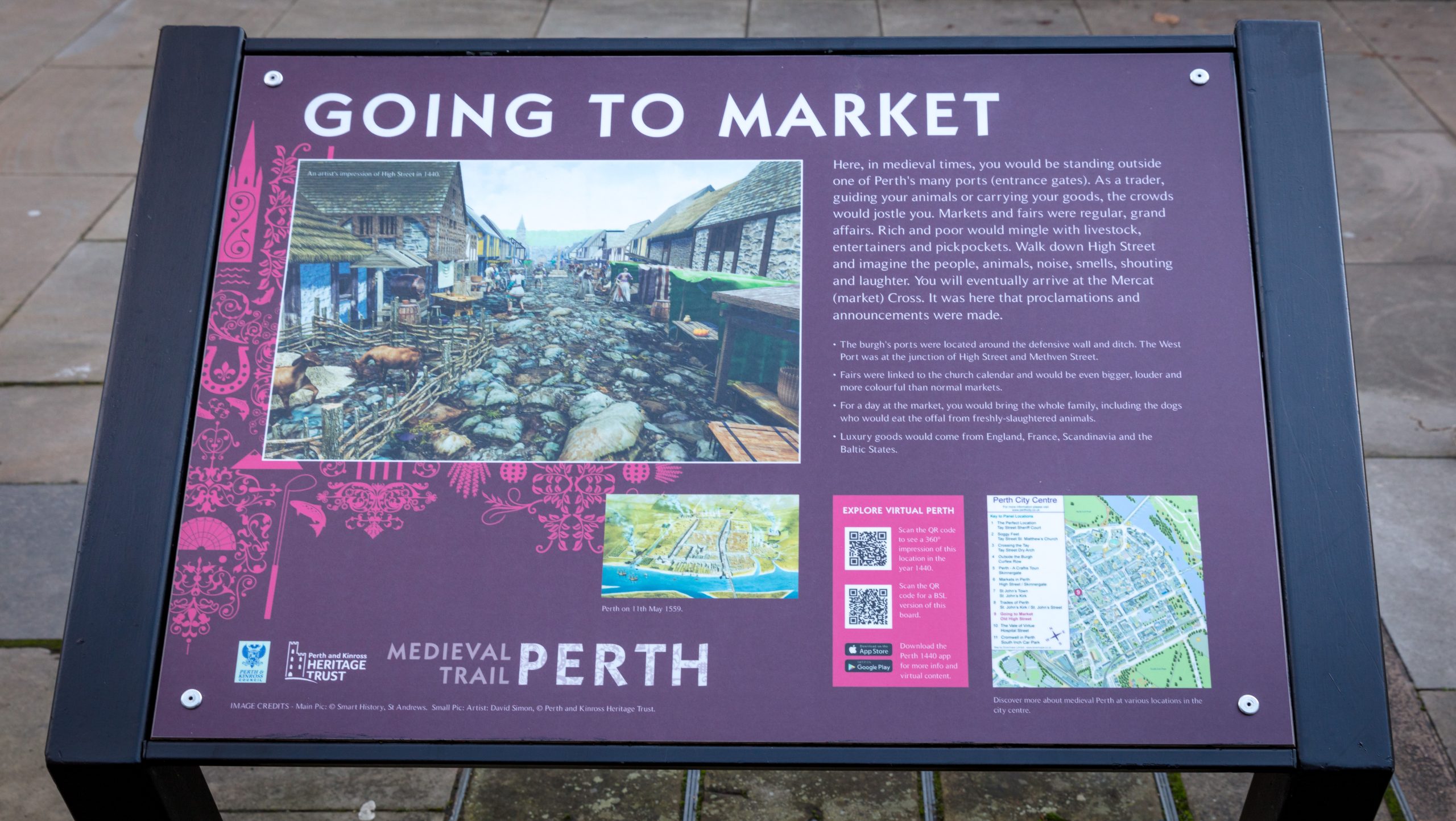
At the junction of High Street and South Methven Street was the old West Port, one of the many entrances to the city in medieval times. Traders would enter her to go to the many markets held within the walls. A modern information board entitled Going to Market (Panel 9 of the Perth Medieval Trail) can be found beside the newly redeveloped St Paul’s Church open-air space.
A stone plaque in the roadway of the High Street near its junction with Skinnergate marks the site of the Old Mercat Cross. A modern information board close-by describes the various markets held over the centuries. This is Panel 6 of the Perth Medieval Trail which replaced an earlier board (also pictured below). Further details of markets and trades are recorded on Panel 8 at St John’s Kirk. The original cross was demolished by Cromwell’s engineers to provide stones for his citadel. It was re-instated in 1669 and this replacement demolished in 1765. It was here in 1746 that Charles…
In medieval times Skinnergate was the main thoroughfare into Perth from the North. Many of the crafts and trades associated with Perth were established there just inside the burgh walls, most notably those associated with leather like the Glovers Incorporation founded in 1210. An information board entitled Perth – A Craftis Toun can be found on Mill Street at the north end of Skinnergate. This is number 5 in the Perth Medieval Trail.